
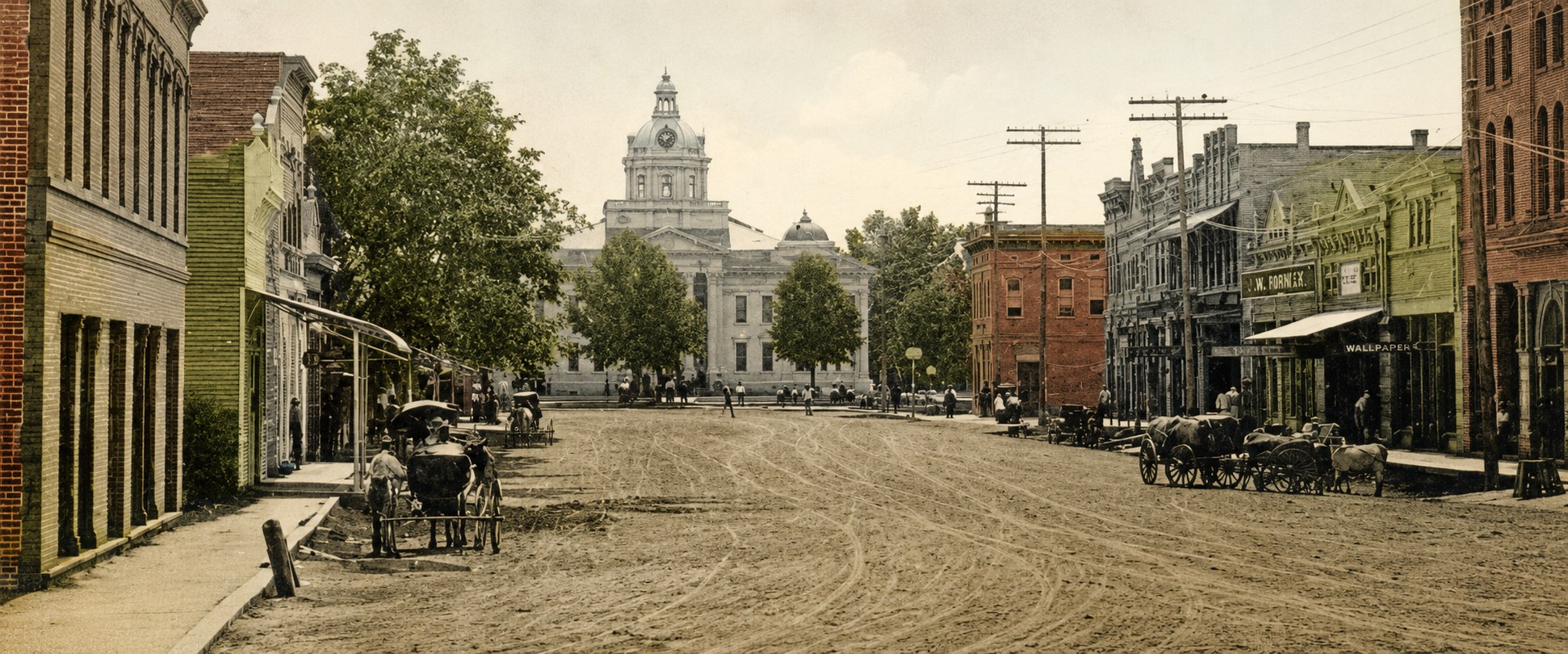
Main Street looking toward the new Marion County courthouse — hand-tinted, early 1900s. Courtesy of the Marion County Historical Society.
Our Story · Incorporated June 25, 1819
Mississippi's fourth city.
Two centuries on the Pearl — and for one remarkable year, the capital of the whole state.
Two centuries
From state capital to Sweetness.
1819 — Columbia becomes Mississippi's fourth incorporated municipality, on the banks of the Pearl.
1821–22 — the state legislature meets here: Columbia serves as Mississippi's temporary capital before Jackson is chosen.
1905 — the Beaux-Arts Marion County courthouse rises at the foot of Main Street, copper dome and four-faced clock above the town ever since.
1907 — the Gulf & Ship Island Railroad opens its passenger depot — today the Marion County museum.
Early 1900s — the Piney Woods lumber boom builds the town; when the timber runs out, Mayor Hugh L. White recruits industry to Columbia — an approach he takes statewide as governor with the famed BAWI program. A small town taught the state how to rebuild an economy.
The organizing was already in place: the Commercial Club of Columbia formed in 1906 — the second-oldest such organization in Mississippi — and it was the chamber that helped land Reliance Manufacturing in 1932. It still works today as the Marion County Development Partnership.
1935 — Mississippi's first rodeo is produced in Columbia, on the high school baseball field — recognized as the first outdoor rodeo in the nation held at night under electric lights. A state historical marker went up in 2018. See the hall of famers.
1954 — Walter "Sweetness" Payton is born here. So were NFL Hall of Famer Jackie Smith and safety Johnathan Abram. Three NFL names from one small town's fields.
Today — a National Register historic downtown, a museum in the 1907 railroad depot, and a Main Street that keeps winning state awards.
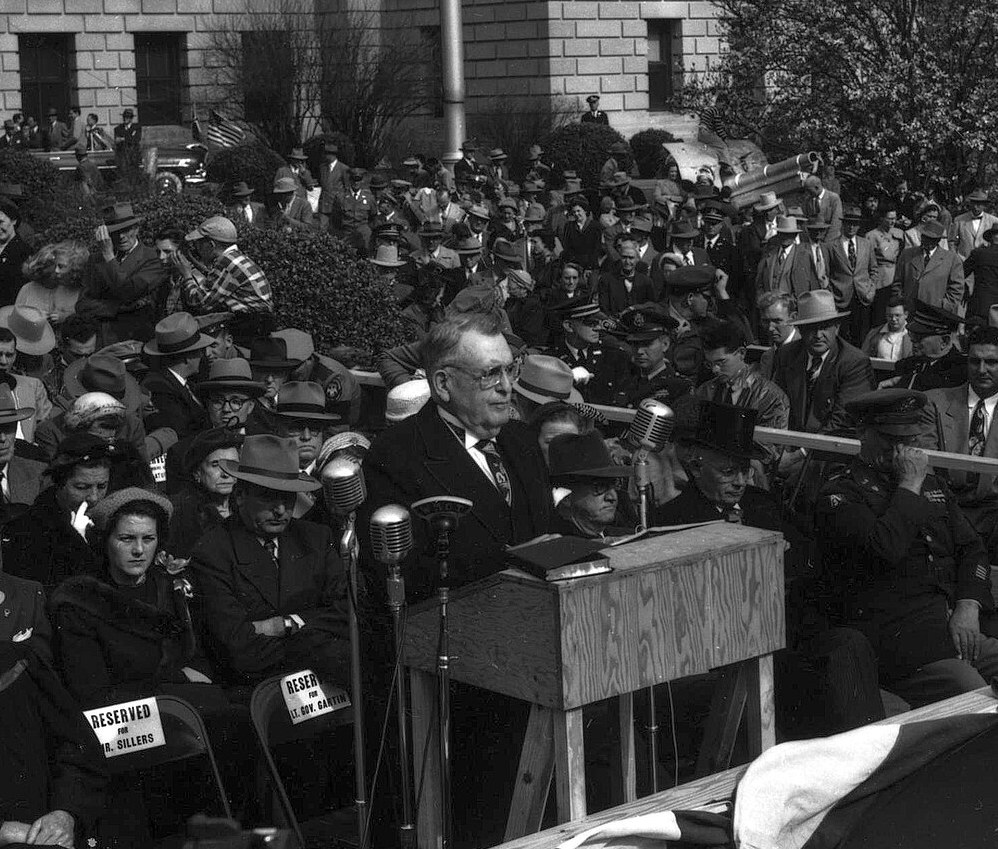 Hugh L. White, mayor 1926–1935
 Hugh L. White, mayor 1926–1935
The mayor who taught the state how to recruit.
When the Piney Woods timber ran out, Columbia's mayor went looking for a payroll.
In the first years of the Depression, Hugh Lawson White approached Reliance Manufacturing Company, a maker of men's dress shirts and pajamas, with an offer: if Columbia guaranteed $85,000 to put up a building, would Reliance bring a plant? Reliance said yes — and promised 300 jobs, growing to 700, and $1 million in wages into the local economy over ten years.
The town raised the money. The plant opened in 1932. It is recorded as the first time Mississippi landed a company using the methods every economic developer now takes for granted — and the Commercial Club of Columbia, formed in 1906, did the organizing.
Four years later White was elected governor, and he took Columbia's idea statewide as Balance Agriculture With Industry. Passed in 1936, BAWI let any Mississippi town issue bonds to build a plant for an incoming employer. Twelve plants went up under it between 1936 and 1940. One of them was Ingalls Shipyard at Pascagoula.
A shirt factory on the Pearl River is a large part of the reason Mississippi builds ships.
And the mechanism outlived the program. A town issuing bonds to build a plant and leasing it to the company is what the country now calls an industrial revenue bond — standard economic-development financing, used in every state. BAWI was the first state-sponsored economic development plan in the nation, and the deal Columbia struck in 1932 was its prototype. Two artifacts at the Trent Lott National Center at Southern Miss tell the story, and one of them is a brick from the Reliance plant.
Hugh L. White at his 1952 inauguration in Jackson. Photograph: Mississippi Department of Archives and History.
 Look up
 Look up
Why there are white squirrels in Columbia.
Hugh White left this town two things. One was an industrial policy the whole state copied. The other was squirrels.
Sometime during his years here, White introduced white squirrels to Columbia. Nearly a century later they are still around — most reliably in City Park — and they still turn up in the pages of the Columbian-Progress. Newcomers spot one, assume they imagined it, and get told the story by whoever is standing nearest.
They are not a tall tale and they are not a mascot somebody invented for a brochure. They are a governor's imported curiosity that never left. Bring a camera, and be quicker than they are.
Walter Payton
Sweetness went to high school here — at two of them.
Walter Payton was born in Columbia in 1954, and for three years he went to John Jefferson High School — the town's segregated all-Black high school. The school district still names it plainly on its own site: John Jefferson High School, now Jefferson Middle School.
Then, in January 1970, the district integrated. For his senior year, Payton was among the Black students who walked into Columbia High School.
Today a statue of him stands at Walter Payton Field at Gardner Stadium, sculpted by Ben Watts — the same Mississippi artist who made It's Columbia at The Yards. His Pro Football Hall of Fame plaque hangs at the Charles L. Boston Athletic Complex, named for his coach.
The short version is that a Hall of Famer came from here. The real version is better: he had to change schools to finish high school in this town, and this town now puts his name on the field.
 Landmarks
 Landmarks
Walk it in an afternoon.
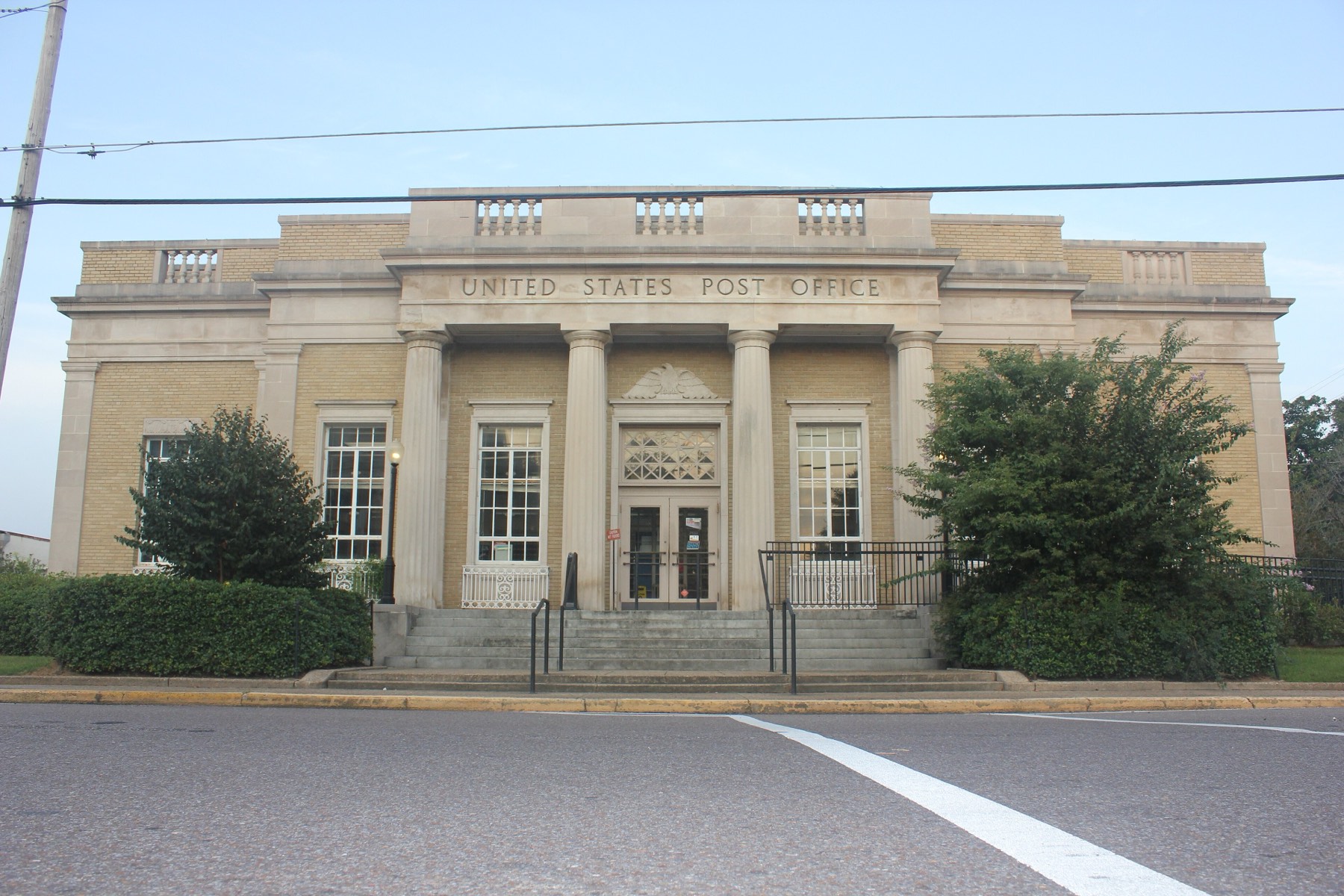
The 1905 courthouse and its copper dome. The Beaux-Arts post office. Storefronts running Italianate to Art Deco along a National Register district. The Marion County museum in the old depot, keeping two hundred years of stories. And the Pearl River Interpretive Plaza, where the river itself is mapped beneath your feet.
See it yourself