
Marion County · Columbia
The buildings that explain the town.
A federal post office built in the Depression, a courthouse dome you can see from the bypass, two historic districts, and a name carried here from South Carolina.
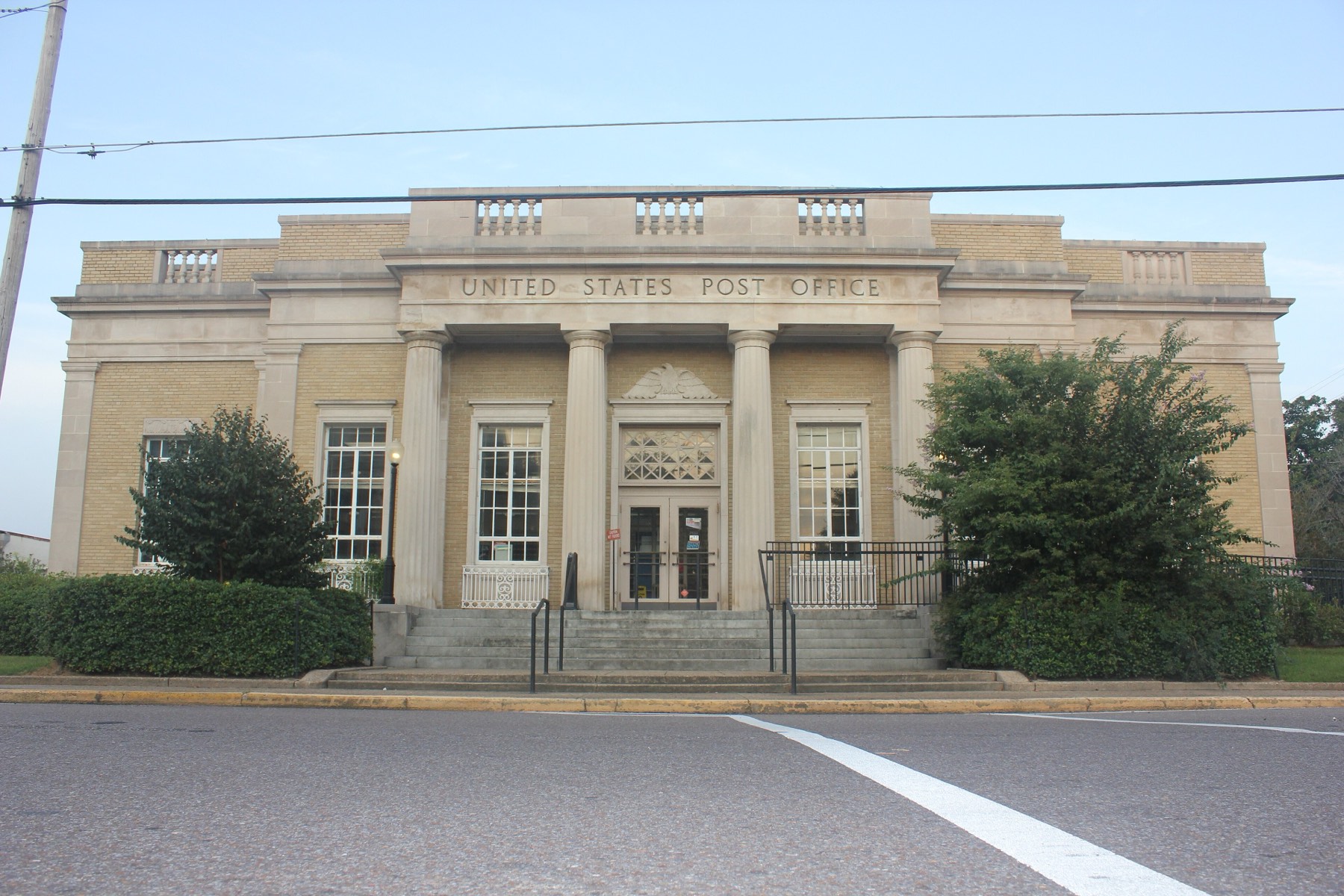 815 Main Street
 815 Main Street
The post office, 1931.
Columbia's post office went up in 1931, designed by the architectural firm Shourds & Bean in a restrained Beaux-Arts style — limestone, a columned entry, and UNITED STATES POST OFFICE cut into the frieze where you can still read it from the street.
It is listed on the National Register of Historic Places as part of Mississippi Post Offices, 1931–1941 — a group listing that recognizes a specific decade when the federal government built substantial public buildings in small Southern towns, and built them to last.
That is the point worth noticing. In 1931 Columbia had roughly five thousand people, and the country was two years into the Depression. It still got a building with columns.
Where the name came from
Columbia is named for Columbus. At three removes.
Not directly — and the indirect route is the interesting part.
Columbus → Columbia. Take Columb- from Christopher Columbus, add the Latin -ia that ends a country's name, and you get "land of Columbus." In the 1730s that word became the poetic name for the American colonies, first appearing in print in 1738 in Edward Cave's Gentleman's Magazine. Columbia then became a person — a woman in classical drapery who stood for America the way Britannia stood for Britain. She came before Uncle Sam, and Lady Liberty descends from her. After the Revolution, when anything named for a king was suddenly out of fashion, towns and colleges reached for her instead. King's College in New York became Columbia in 1784.
Columbia, South Carolina, 1786. State Senator John Lewis Gervais introduced the bill creating a new capital, approved March 22, 1786. One legislator wanted to call it Washington. Columbia won, 11 votes to 7. Gervais said he hoped that "in this town we should find refuge under the wings of COLUMBIA."
Columbia, Mississippi. Named for that Columbia, by settlers who came from South Carolina — the same migration that brought the Lotts, the county's name, and the Foxworths.
So the chain runs: a Genoese navigator → a Latin coinage → a woman who personified a country → a capital city that came within four votes of being called Washington → this town on the Pearl River. Had that 1786 vote gone the other way, Columbia, Mississippi might have been Washington, Mississippi.
Why we're called Marion
The Swamp Fox never came here.
Marion County is named for General Francis Marion — the Revolutionary War commander the British called the "Swamp Fox."
Marion fought in South Carolina. After Charleston fell in 1780 he took his men into the swamps and made a career of being impossible to catch: fast raids on British and Loyalist forces, then back into terrain that regular troops couldn't follow. The nickname came from the man chasing him — Banastre Tarleton, in November 1780, gave up the pursuit and reportedly complained about "the swamp fox." The insult stuck as a compliment, which is the best kind.
He never set foot in Mississippi. The name came here in people's luggage.
The South Carolina thread
So where do all the Foxworths come from?
It's a fair question with a better answer than you'd guess — and it has nothing to do with foxes.
Marion County, Mississippi was established by John and William Lott, who were natives of South Carolina. Columbia is named for Columbia, South Carolina, because that is where a great many of the first settlers came from.
And Foxworth, just down the river, is named for Frank W. Foxworth, who settled it after moving across the Pearl. His father had come to Mississippi from Marion County, South Carolina — a county also named for Francis Marion — and settled about two miles northeast of Foxworth, near Columbia.
So the connection is real, it's just geographic rather than vulpine. The Foxworth family moved from one Marion County to another, and both counties are named for the same man. A whole corner of Mississippi is essentially South Carolina, relocated — the county name, the town name, and a good number of the surnames still in the phone book.
Sister cities
Two hundred years later, they took care of each other.
The connection to Columbia, South Carolina is not just a name on a map. It is official — and it was earned.
When a tornado tore through Columbia, Mississippi and killed three people, South Carolinians came to help. Then in October 2015, Hurricane Joaquin flooded South Carolina, and Columbia, Mississippi sent two large truckloads of water back to Columbia, South Carolina.
On August 18, 2016, Catherine Fleming Bruce of the Columbia, South Carolina City Council drove to Mississippi to hand over a resolution her council had passed that week: Columbia, Mississippi was formally designated a sister city of Columbia, South Carolina.
A town of six thousand was thanked, in writing, by a state capital — for showing up. The same instinct built Columbia Strong after that tornado, and Columbia Strong went on to raise $650,000 toward the inclusive playground at Friendship Park.
The town Columbia was named after, in 1819, is the town Columbia sent water to in 2015. It took two centuries for the favor to run both directions.
On the National Register
Two historic districts and a dome.
Marion County Courthouse — the Beaux-Arts courthouse rose at the foot of Main Street in 1905. Copper dome, four-faced clock, visible from most of town. It is the shape this website's own icon is drawn from.
Broad Street–Church Street Historic District — added to the National Register on July 8, 2008. A street named Church Street, lined with churches, on the federal register. See Houses of Worship.
Keys Hill Historic District — on Broad Street, listed in part for its association with Gov. Hugh Lawson White, whose mansion stands there: built 1925–27 by Jackson architect Claude H. Lindsley, Spanish Colonial Revival, with a sunken Italian garden and a reflecting pool.
The 1907 depot — the Gulf & Ship Island Railroad's passenger station, now the Marion County Museum and Archives at 200 Second Street
Birthplace of Mississippi Rodeo — a state historical marker erected in 2018, for the rodeo held here in September 1935: the first outdoor rodeo in the nation staged at night under electric lights. The story is on the hall of famers page.
The Walter Payton plaque — the Pro Football Hall of Fame's Hometown Hall of Famer bust and plaque, installed November 2011 at the Charles L. Boston Athletic Complex at Columbia High School.
1021 North Main Street
On the National Register since 2009.
At the corner of Mayson Avenue and North Main stands a house worth stopping for: a six-bay front under a hip-on-hip roof, carried on brick piers with lattice infill, fluted Tuscan columns along the porch and a decorative cast-iron rail running between them. The entry door carries nine lights over a panel, flanked by six-light sidelights and a matching transom — door, sidelights and transom all cut to the same pattern.
The National Register survey files it as Colonial Revival, built about 1900, and notes that the second storey came later, set back so it doesn't crowd the original roofline. Those raised piers and the long shaded gallery are Gulf Coast habits that outlived the style label.
It is a contributing building in the Columbia North Residential Historic District, listed on the National Register of Historic Places in 2009 — as is the c. 1940 garage and apartment behind it. The Jordan family has kept it for generations, and Mayson Avenue beside it carries the name of another old Columbia family.
Contributing status is not just an honour — it makes a house eligible for a 25% Mississippi rehabilitation tax credit. There are 345 contributing buildings in the district. See whether yours is one.
Still being made here
Copper lanterns, shipped everywhere.
St. James Lighting has been handcrafting copper lanterns and chandeliers in Columbia since summer 2008. Founder Jim Ragan builds fixtures that go to customers across the United States and Canada.
In 2013 the company put $225,000 into expanding, created twenty jobs, more than doubled its workforce, and moved into the building the Orleans Furniture plant had occupied. It employs upwards of twenty-five people now, at 1491 Highway 13 North.
The craft is specific enough that only a handful of the shop's employees are qualified to build every part of a fixture — the rest specialize. That is an unusual thing to be able to say about a manufacturer in a town of six thousand, and it is the same story Columbia has been telling since Hugh White talked a shirt factory into moving here in 1932: the work is here because somebody made it be here.
By Friendship
The Water Works Building.
The Water Works Building, out by Friendship, is a Columbia landmark for a reason most people have forgotten: Hugh White gave a campaign speech from it.
A photograph exists of White speaking there — the mayor who had already talked a shirt factory into town, addressing the people who would send him to Jackson. The building where a governor campaigned is still standing, and it is a water works.
We would like that photograph on this page. If the museum or a family has a copy, tell us.
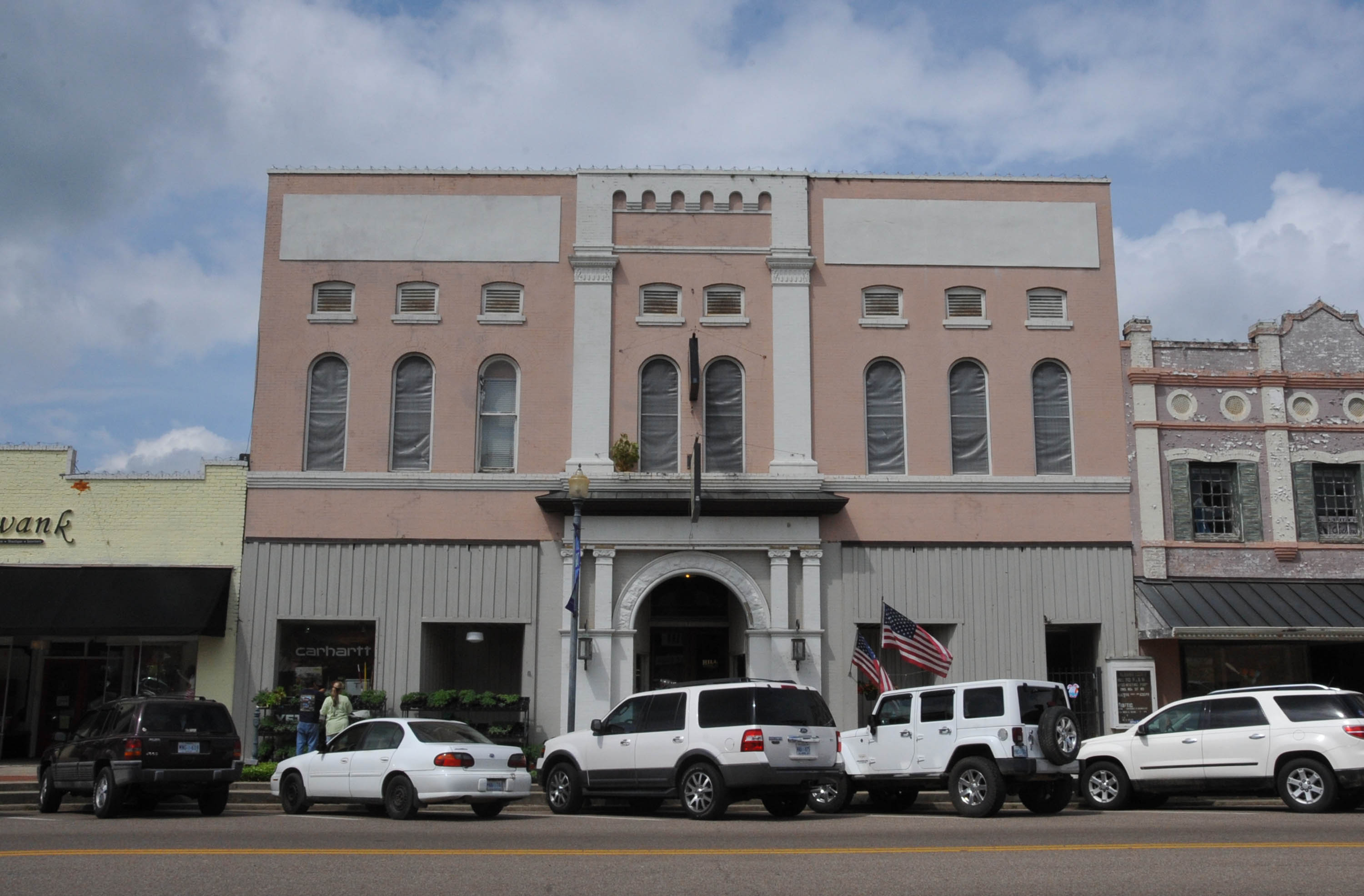 717 Main Street · since 1901
 717 Main Street · since 1901
Hill Hardware has outlasted everything.
W. A. Hill opened Hill Hardware in 1901 on a simple idea: keep as much as possible under one roof. It sold tools, cookware, groceries and wagon repairs, and it bought and sold cotton. The original store stood where Trustmark Bank is now.
A fire in 1916 took that building. In 1919 two things happened: St. Albans Masonic Lodge #60 bought the building and began meeting on the third floor, and a longtime employee named Curtis Morgan bought the business. Morgan's son Van ran it after him. Leon and Patty Bohuslav took over in 1974, and in December 2025 it passed to Ryan Breakfield.
So it is the oldest business in Columbia — four ownerships in a hundred and twenty-five years, and the Masons are still upstairs. Chains have come and gone on the bypass the whole time.
That is Hill Hardware in the photograph. Look above the arch and you can read the name.
1937 · N. W. Overstreet
Architecture students study Columbia High School.
Columbia's high school, built in 1937, was designed by Noah Webster "Webb" Overstreet — born in 1888 in Eastabouchie, another Piney Woods sawmill town, and known as "Mississippi's First Architect." He was the first Mississippian inducted into the American Institute of Architects' College of Fellows, and A. Hays Town — who became one of the South's most imitated residential architects — worked in his office from 1926 to 1939.
The Mississippi Encyclopedia places Columbia High among Overstreet's "streamlined Depression-era public works buildings" and calls it "the boldly composed Columbia High School" — a building that "resounded with the era's curious mixture of disillusionment and determination."
Here is the part that surprises people: it was a Public Works Administration project in a town of a few thousand, and it was published internationally when it was finished — including recognition in the French architectural journal L'Architecture d'Aujourd'hui. A small-town Mississippi high school, reviewed in Paris. It has since been restored by Albert & Associates Architects, and it is still studied in architecture classes.
And the same building is where Walter Payton finished high school in 1970. The Hometown Hall of Famer plaque is on the athletic complex there.
Note the run of years: the post office in 1931, Reliance in 1932, BAWI in 1936, this school in 1937. The Depression built most of what people photograph downtown.
Two photographs we are looking for
Help us fill these two frames.
Two images belong on this website and we cannot find either one in any archive we can reach. Both are almost certainly sitting in a shoebox or a filing cabinet somewhere in Marion County.
① Hugh White giving a campaign speech at the Water Works Building. Reserved slot: /landmarks, beside the Water Works section. Every freely-licensed Hugh White photograph in existence — all seventeen of them — is from his 1952 inauguration in Jackson. Not one is from Columbia. The likeliest holder is the Marion County Museum & Archives, 200 Second Street · 601.731.3999.
② Eddie and Walter Payton together. Reserved slot: /hall-of-fame, in the Walter Payton section. No freely-licensed photograph of the brothers exists; the rest are wire-service or family images we cannot publish without permission. Eddie Payton keeps a personal collection of Payton memorabilia, and a photo from him would come with permission attached.
If you have either one — or a photograph of the old Reliance plant, the 1935 rodeo, or Main Street before the fire — send it to us. Scanned or photographed on a phone is fine. Credit goes wherever you tell us it goes.
Main at Second
The little building that was the police station.
On the corner of Main and Second stands a small building most people walk past without a second look. It was Columbia's original police station. Today it is the Main Street building — the office of the downtown program.
That is a neat piece of civic recycling: the building where the city once booked people is now the building where somebody's whole job is getting more people to come downtown. Same address, opposite purpose.
It is also a useful landmark for finding your way around, because Main and Second is effectively the centre of everything — City Hall is a block away at 201 Second Street, the post office sits up Main at 815, and Hill Hardware is at 717.
See Main Street Columbia for what the program does from inside it.
Columbia Springs · 1826
The apology in his pocket.
Early in the nineteenth century Charles Stovall built a three-storey hotel on the Pearl just outside town and called it Columbia Springs — locals called it Stovall's Springs. Three storeys of wood frame, suites on every floor, verandas looking out over the Pearl, and interiors finished in mahogany, oak and walnut — it became the most famous health retreat in south Mississippi, pulling planters, politicians, merchants and lawyers up from New Orleans and Natchez. In 1821 it briefly housed the state legislature — the same season Columbia served as Mississippi's temporary capital.
In the summer of 1826, at a formal dinner there, Richard Stockton — Mississippi's Attorney General, and the son of a signer of the Declaration of Independence — quarrelled with a New Orleans merchant named Payson. Neither man let it go. The grievance travelled with them, and in early 1827 they met with pistols in New Orleans. Payson's shot hit Stockton in the head and killed him.
Here is the part that stays with you. Stockton had already written a note. In it he said his own conduct had been rash and wrong from the beginning, and that he meant to apologize — after he had stood and taken the first volley. Honour first, then the truth he had been carrying the whole time. He never got to deliver it. Payson drowned in the Mississippi River a few years later, around 1830.
There was a second duel out of the same summer: a planter named Ross and a Jefferson County attorney named Gibbs faced each other near Grand Gulf with muskets, and both fell mortally wounded at the first fire — one dead within hours, the other lingering for months. Stockton had served as the surgeon at that one.
Two duels out of one hotel was more than its reputation could carry. Columbia Springs closed and never reopened. By 1891 a writer passing through noted that "scarcely a vestige of the hotel now remains."
No photograph of Columbia Springs is known to survive — it was ruins before cameras were common here. But it was not lost entirely. In 1975 the Columbian-Progress ran an artist's reconstruction of the hotel, drawn by Tommy Daughtry, a Project Transfer art specialist with the Columbia schools, "from descriptions furnished by local citizens who remembered the building before it was torn down." People who had stood in front of it told him what it looked like, and he drew it.
⭐ And the clipping carries something bigger. It records that Stovall Springs was "the meeting place of the Mississippi Legislature for two terms" — and that it was from a Columbia session of the Legislature that surveyors were sent out to locate Jackson. The decision that put the state capital where it now sits was taken in a hotel on the Pearl River, in this town.
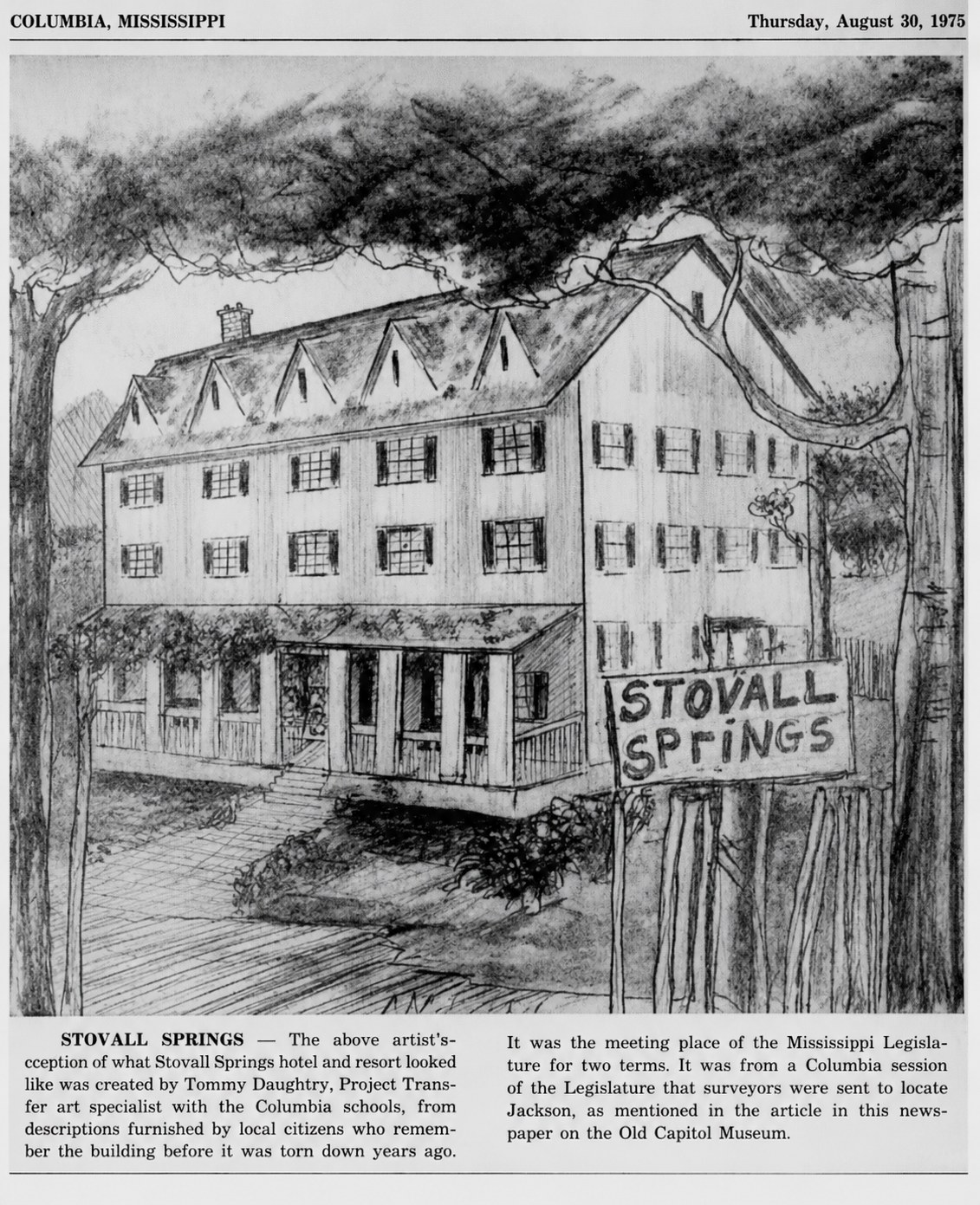 Columbian-Progress · 30 August 1975
 Columbian-Progress · 30 August 1975
Drawn from memory, fifty years on.
This is the closest thing to a picture of Columbia Springs that exists.
Tommy Daughtry never saw the hotel — it had been torn down years before he drew this. What he had was the memory of people who had. He interviewed citizens who could still describe the building and reconstructed it from what they told him: three storeys, dormers along the roofline, the columned gallery, and a hand-lettered sign at the road.
It ran in the Columbian-Progress on Thursday, 30 August 1975, beside a story about the Old Capitol Museum — because of the connection in the caption: the surveyors who located Jackson were sent from a legislative session held here.
Drawing by Tommy Daughtry. Published in the Columbian-Progress, 30 August 1975.
Since 1882
The Columbian-Progress has outlasted nearly everything.
The Columbian-Progress has been reporting on Marion County since 1882 — more than 140 years, which puts it ahead of Hill Hardware by nineteen years and makes it one of the oldest continuously operating institutions in the county. It still comes out every Thursday.
It is also good at the job. The paper has taken six General Excellence awards as the best overall newspaper of its size in Mississippi.
Worth knowing if you go looking for old issues: the hyphenated name is a merger, and archive collections list the Columbian-Progress title running from 1909, while the paper dates its own service to the county from 1882. Both numbers are right — they are just measuring different things.
Nearly every date on this website was checked against something, and a good share of those somethings were Columbian-Progress stories.
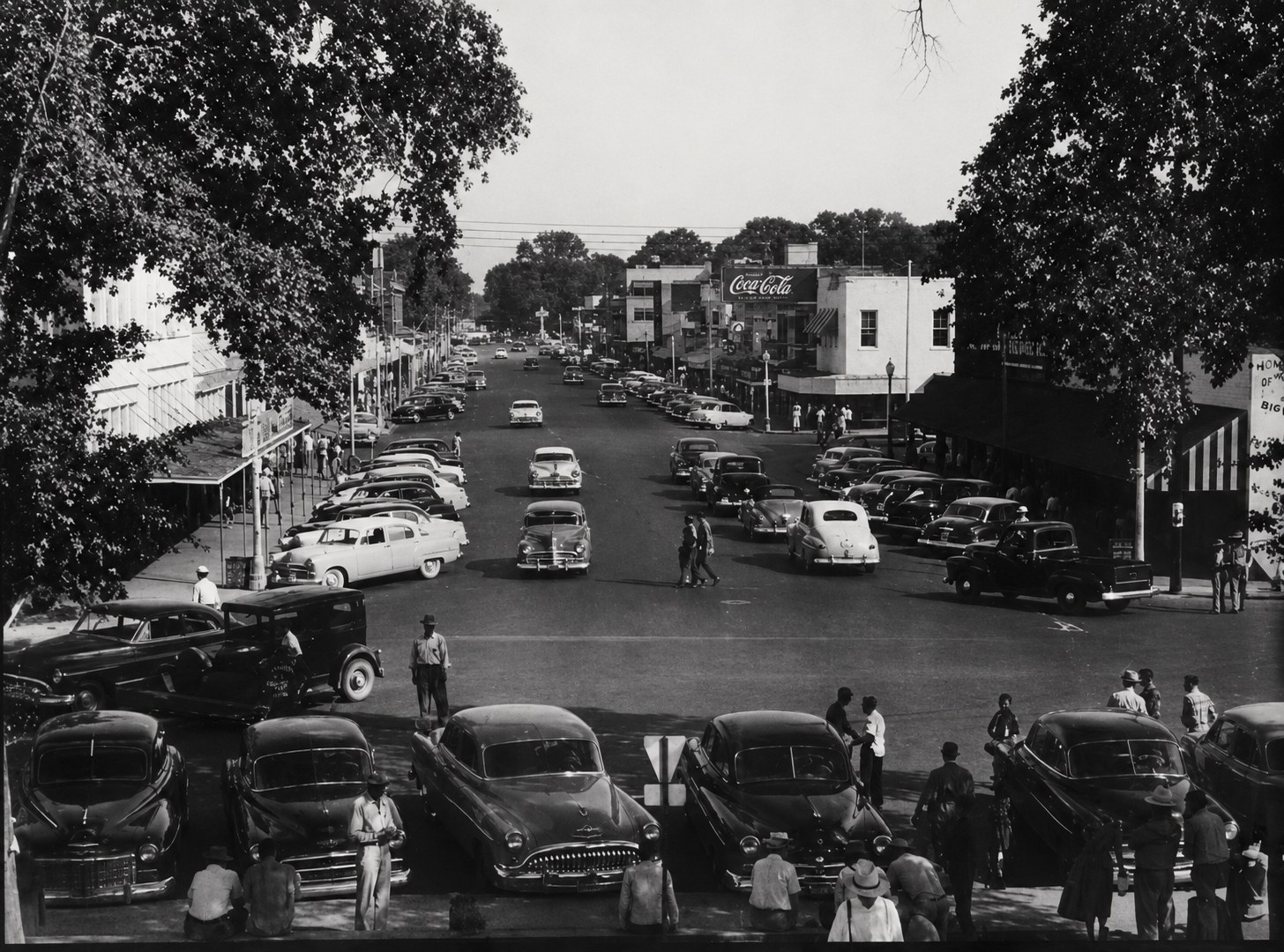 The same buildings, in use
 The same buildings, in use
Main Street on a busy day.
Nearly every building on this page appears in this photograph, doing the job it was built for. The Coca-Cola wall sign, the awnings, the diagonal parking, and a crowd thick enough that people are standing in the street.
It is worth holding this image beside the post office and Hill Hardware sections above. Those buildings did not survive as monuments — they survived because a town kept using them, and two of them are still open for business today.
Shot from elevation, most likely the courthouse steps — the one place in Columbia where you can see the whole street at once.
Know a landmark we missed?
Every old building has somebody who knows it.
This page is short and the town is old. If there's a building, a marker, or a house with a story that belongs here — especially if you have the documentation — send it to us.